what would a spacecraft to mars look like
There are many things humanity must overcome before any return journey to Mars is launched.
The two major players are NASA and SpaceX, which piece of work together intimately on missions to the International Space Station but take competing ideas of what a crewed Mars mission would expect like.
Size matters
The biggest challenge (or constraint) is the mass of the payload (spacecraft, people, fuel, supplies etc) needed to make the journey.
We still talk most launching something into space being like launching its weight in gold.
The payload mass is usually just a small percentage of the total mass of the launch vehicle.
Baca juga: Buried lakes of salty water on Mars may provide weather for life
For example, the Saturn V rocket that launched Apollo 11 to the Moon weighed 3,000 tonnes.
Just it could launch only 140 tonnes (v% of its initial launch mass) to depression Earth orbit, and 50 tonnes (less than 2% of its initial launch mass) to the Moon.
Mass constrains the size of a Mars spacecraft and what it can do in space. Every manoeuvre costs fuel to burn rocket motors, and this fuel must currently be carried into infinite on the spacecraft.
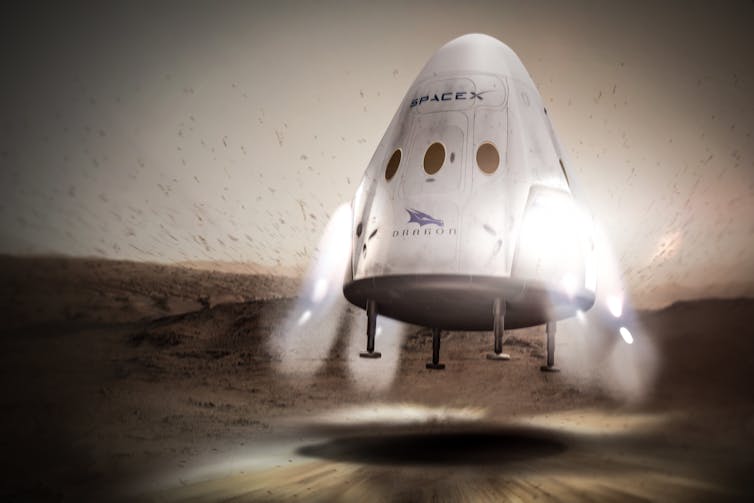
SpaceX'due south plan is for its crewed Starship vehicle to be refuelled in space by a separately launched fuel tanker. That means much more fuel can be carried into orbit than could exist carried on a single launch.
Time matters
Another challenge, intimately continued with fuel, is fourth dimension.
Missions that ship spacecraft with no crew to the outer planets often travel complex trajectories around the Sun. They use what are called gravity assistance manoeuvres to finer slingshot effectually different planets to gain enough momentum to reach their target.
This saves a lot of fuel, only tin result in missions that have years to attain their destinations. Clearly this is something humans would not want to practice.
Both Earth and Mars take (almost) circular orbits and a manoeuvre known as the Hohmann transfer is the most fuel-efficient way to travel between two planets. Basically, without going into besides much detail, this is where a spacecraft does a single burn into an elliptical transfer orbit from one planet to the other.
A Hohmann transfer betwixt Earth and Mars takes around 259 days (between viii and nine months) and is only possible approximately every ii years due to the different orbits effectually the Sun of Globe and Mars.
A spacecraft could attain Mars in a shorter time (SpaceX is claiming vi months) merely — y'all guessed it — information technology would price more fuel to practise it that way.
Condom landing
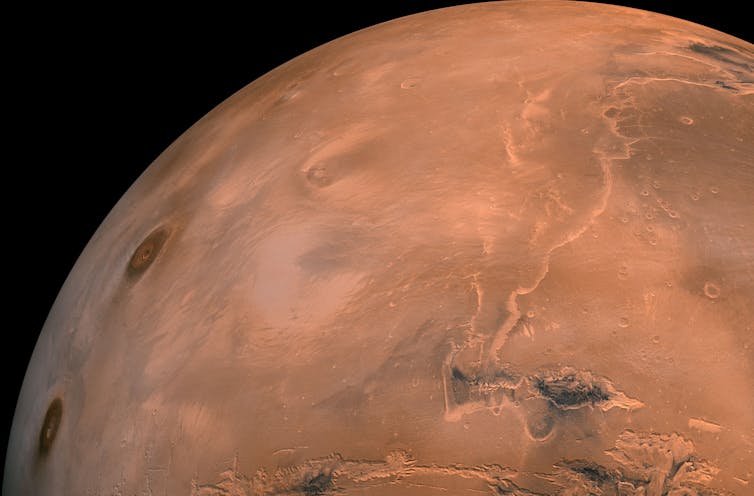
Suppose our spacecraft and crew get to Mars. The side by side challenge is landing.
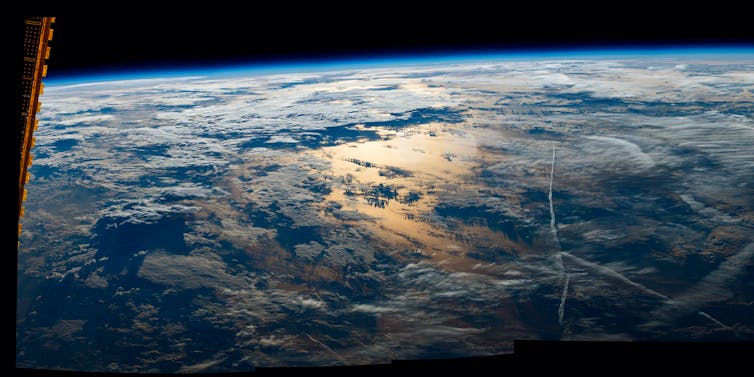
A spacecraft entering Earth is able to use the drag generated by interaction with the atmosphere to slow down. This allows the craft to land safely on the Earth's surface (provided it tin can survive the related heating).
But the temper on Mars is nearly 100 times thinner than Earth'due south. That means less potential for elevate, so it isn't possible to land safely without some kind of aid.
Some missions have landed on airbags (such as NASA'southward Pathfider mission) while others have used thrusters (NASA's Phoenix mission). The latter, once again, requires more fuel.
Life on Mars
A Martian day lasts 24 hours and 37 minutes but the similarities with Earth stop at that place.
The thin temper on Mars ways it can't retain rut as well as Earth does, so life on Mars is characterised by large extremes in temperature during the day/night cycle.
Mars has a maximum temperature of 30℃, which sounds quite pleasant, simply its minimum temperature is -140℃, and its average temperature is -63℃. The average winter temperature at the Earth's South Pole is nigh -49℃.
So nosotros need to be very selective about where nosotros cull to live on Mars and how nosotros manage temperature during the night.
The gravity on Mars is 38% of Earth's (so yous'd feel lighter) only the air is principally carbon dioxide (CO₂) with several percent of nitrogen, so it's completely unbreathable. We would need to build a climate-controlled identify merely to live there.
SpaceX plans to launch several cargo flights including critical infrastructure such as greenhouses, solar panels and — y'all guessed it — a fuel-product facility for return missions to Earth.
Life on Mars would be possible and several simulation trials have already been done on Earth to run into how people would cope with such an existence.
Return to Earth
The final challenge is the return journeying and getting people safely back to Earth.
Apollo 11 entered World's temper at near twoscore,000km/h, which is only beneath the velocity required to escape Earth's orbit.
Spacecraft returning from Mars will have re-entry velocities from 47,000km/h to 54,000km/h, depending on the orbit they utilise to arrive at Earth.
Baca juga: Honey diary: the Sun never set on the Arctic Mars simulation
They could slow downwardly into low orbit around Earth to around 28,800km/h before entering our atmosphere merely — you lot guessed information technology — they'd need extra fuel to do that.
If they just barrel into the atmosphere, it will do all of the deceleration for them. We but need to make sure we don't kill the astronauts with Yard-forces or burn them upwards due to excess heating.
These are just some of the challenges facing a Mars mission and all of the technological edifice blocks to accomplish this are in that location. We simply demand to spend the time and the money and bring it all together.
griffinsamesessuld.blogspot.com
Source: https://theconversation.com/how-to-get-people-from-earth-to-mars-and-safely-back-again-150167

Post a Comment for "what would a spacecraft to mars look like"